Project Overview
This self-directed SEO research project used my live portfolio as the research subject. The goal was to improve the site's search visibility, clarify the strongest freelance search opportunity, and keep the site positioned broadly around SEO, analytics, and digital marketing for long-term career growth.
Objective
Identify search opportunities that could attract freelance clients, prioritize the strongest keyword-to-page strategy, and preserve broader positioning around SEO and analytical marketing.
My Role
Keyword Researcher and SEO Strategist. I expanded seed topics, collected keyword metrics, classified search intent, assessed business relevance, reviewed SERPs manually, clustered terms by page overlap, mapped keywords to pages, and created on-page recommendations.
Research & Discovery
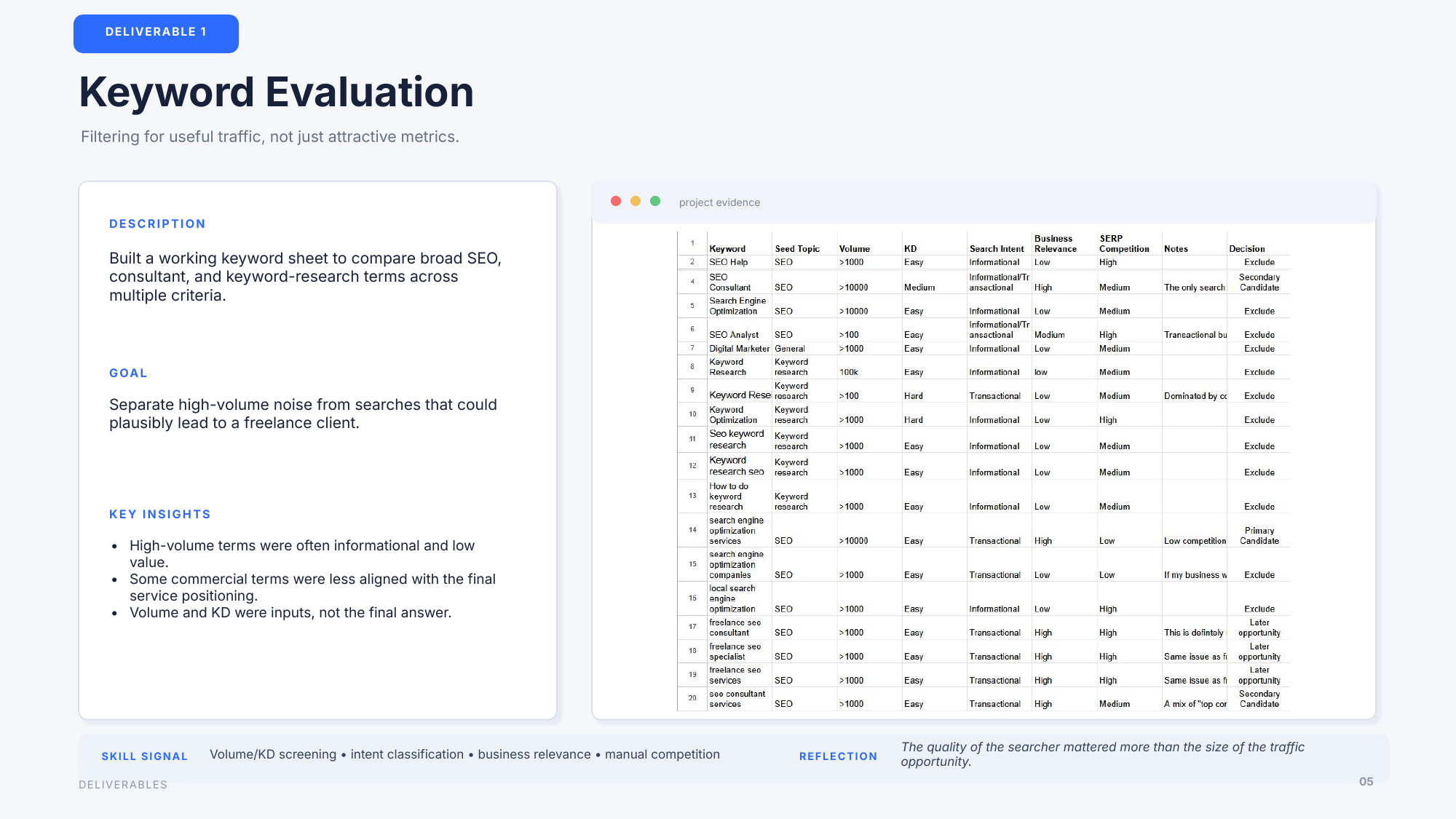
I used Google Search Console, Ahrefs free tools, manual Google SERPs, Semrush's free tier, and Excel. The evaluation combined search volume and keyword difficulty with intent, business relevance, manual competition review, dominant page type, and exact ranking URL overlap. The research showed that high-volume terms were often informational or poorly aligned with the site's client-facing goal.
Strategy
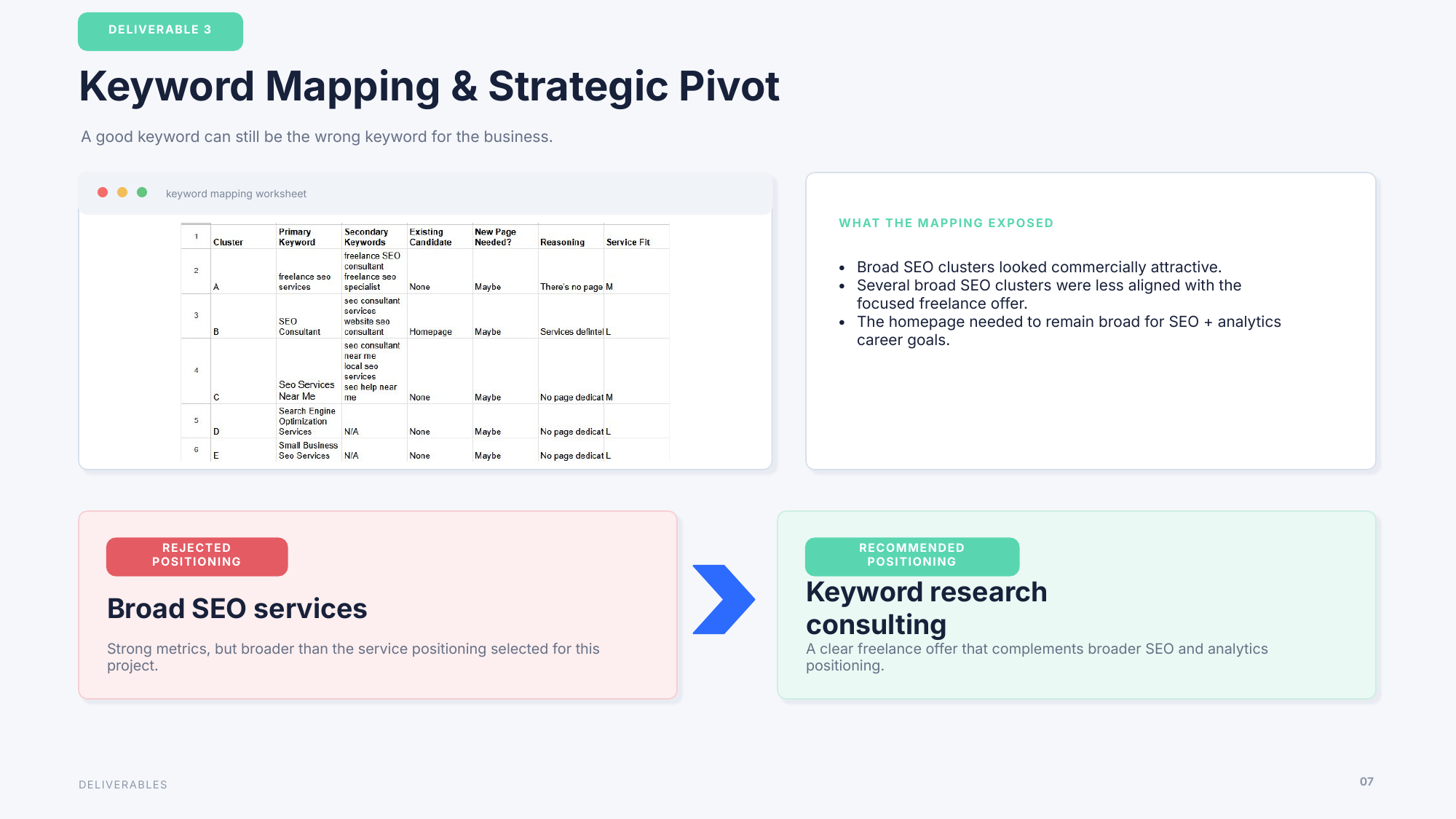
I let SERP patterns define topic boundaries instead of grouping keywords by wording alone. Broad SEO service terms looked commercially attractive, but mapping and service-fit analysis showed that a focused keyword research consulting offer created a clearer opportunity while allowing the homepage to retain broader SEO and analytics positioning.
Execution
- Built a keyword evaluation worksheet covering volume, KD, intent, business relevance, SERP competition, notes, and prioritization
- Compared dominant page types and exact ranking URLs to cluster keywords by shared intent
- Mapped keyword clusters to existing pages and potential new pages
- Selected keyword research consultant as the primary service-page target
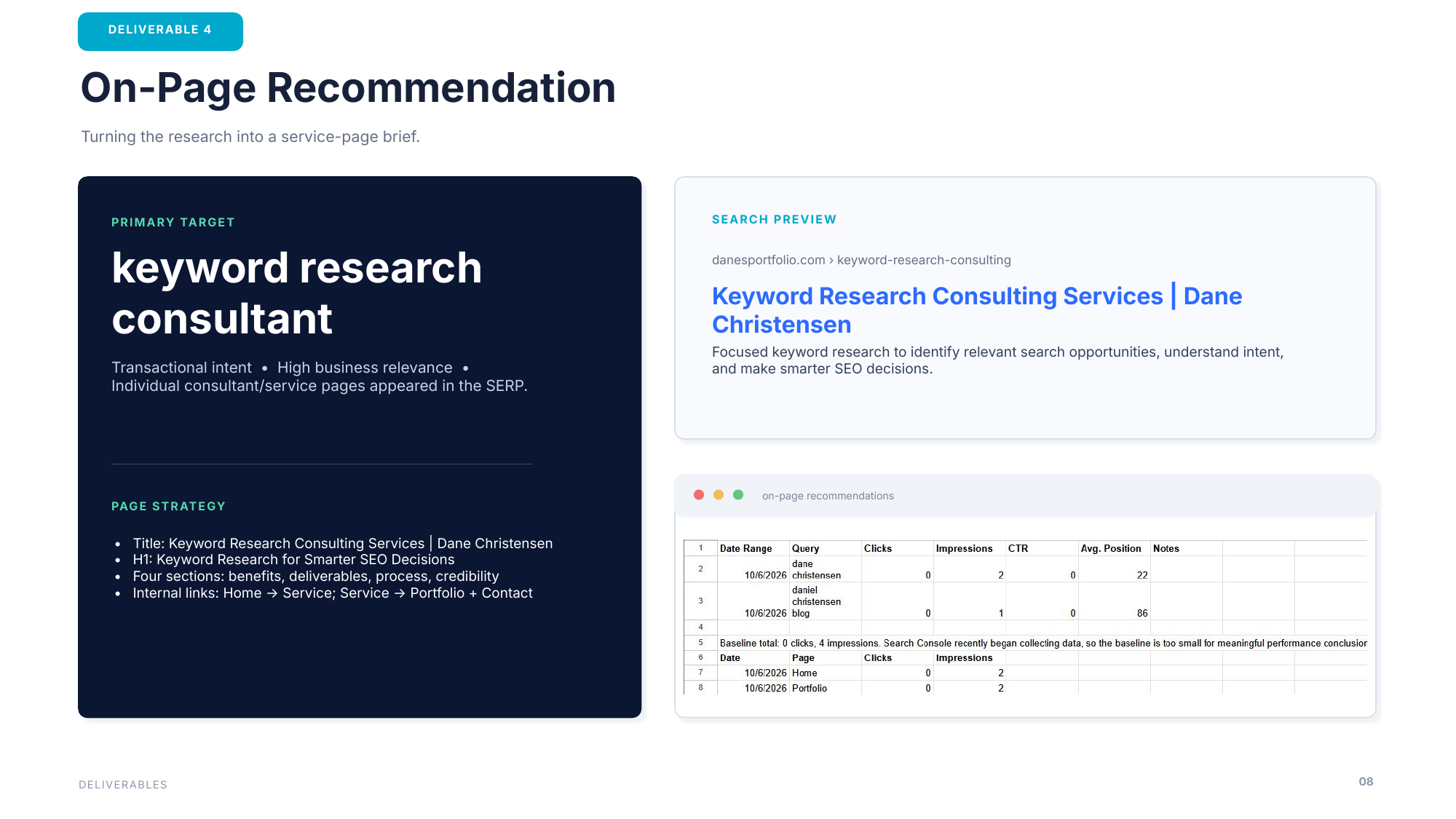
- Created a page brief with title tag, H1, supporting topics, internal links, and conversion goal
- Recorded an initial Google Search Console baseline for future measurement
Results / Project Output
The project produced a focused keyword research consulting page strategy supported by keyword data, manual SERP evidence, clustering, and page mapping. The recommended page targets transactional search intent and connects the service page to the homepage, portfolio, and contact path. Search Console had only recently started collecting data, so the recorded baseline was 0 clicks and 4 impressions, with the new service page beginning from a zero-impression baseline.
Lessons Learned
High search volume is not the same as high value. The SERP can overturn what looks attractive in a spreadsheet, and a keyword becomes a strong recommendation only when search intent, page type, business relevance, and service fit align. This process gave me a repeatable framework for future SEO and client research.